I guessed we launched Record? So why use it over Google?
Published: August 21, 2026
We ripped the bandaid off and made Record live without any fanfare, just putting it out into the world to see what the reaction is. It's not perfect but this is the worst it will ever be.
Why use Record?
It's the first question everyone asked me over the last couple of week as we've started to share early versions of the tool around, and it's a fair one. Google is free. ChatGPT is right there. Why would I go to a new platform to find entertainment technology?
I thought it could be good to start with what I've learnt about search and indexes. I'll do my best to make this easy to understand, I'm still figuring this out. If there's some I've $ucked up, please let me know. I'm here to learn.
What is Google
Google is a web search engine: it indexes pages across the internet and ranks them by relevance and authority, making it superb at finding pages — and indifferent to whether any of them is the product you needed.
How about an LLM?
ChatGPT, Claude, Gemini are prediction engines: they learned from a snapshot of the internet months ago and answer from what they remember, fluently and confidently, regardless of whether the field has moved since. **yes some new models scrap the internet live but they aren't pulling from everywhere, they can't.
What is Record?
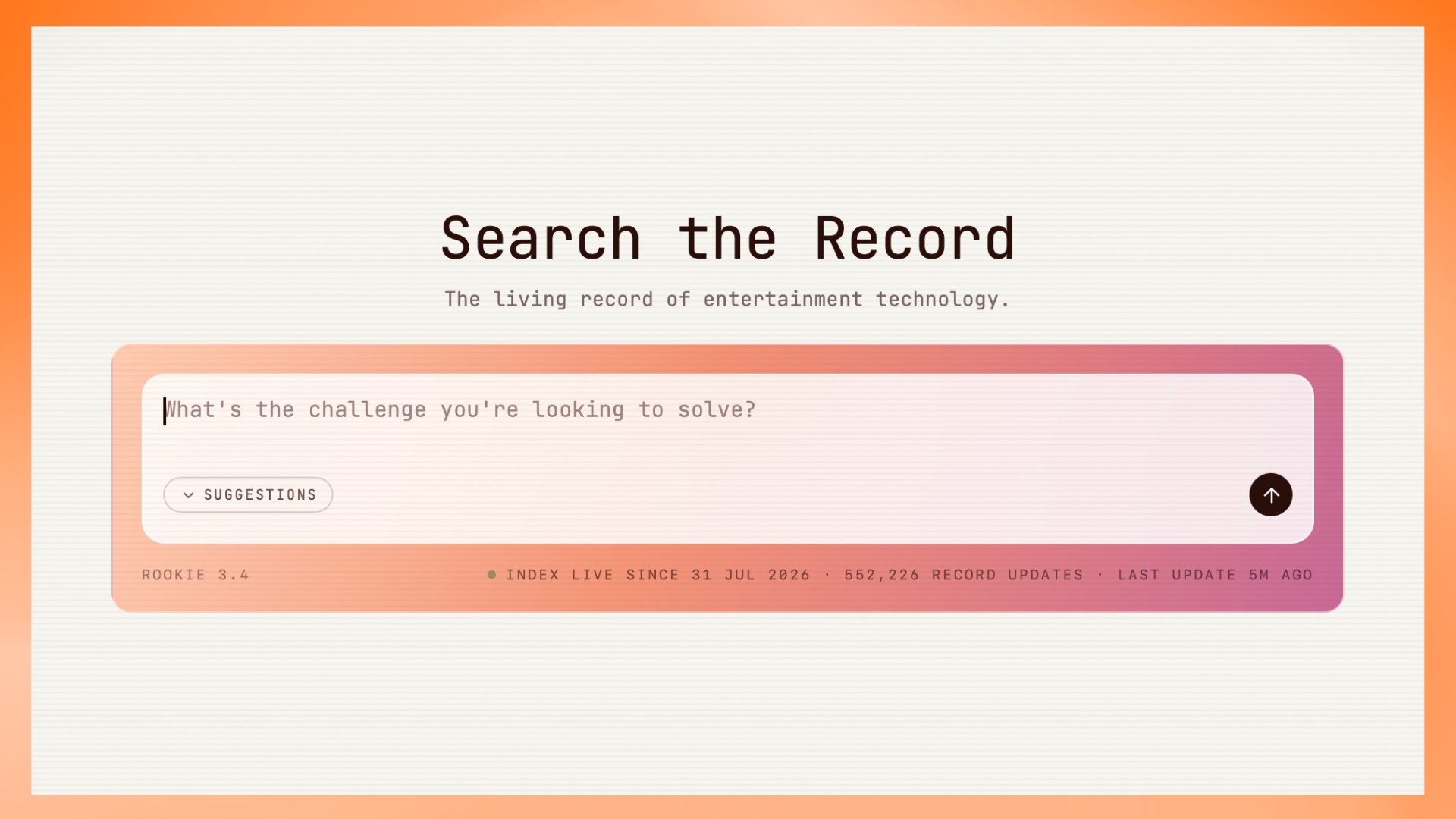
Record is a living index of the technology built for the entertainment industry. Hundreds of sources that we've followed and built over time, producing Thousands of companies, each profiled from its own website, every claim verified against the source, updated weekly.
What we found
We ran 150 real questions, the kind people actually type into Record. We pitted Record against ten frontier AI models, and Google search.
Models know the canon.
Ask an AI for software and you get the well-known answer. Accurately, confidently, and identically to everyone else who asked. 72% of Record's recommendations were companies *no other engine in the test named*. A model is remembering its training data. Record reads an index that updates weekly.
Models drift out of the industry
When asked about running venues and managing artists, frontier models recommended generic business software (Asana, Notion, Shopify) up to 11% of the time. Record did it 0.1% of the time. Once. If you've ever asked an AI a specialist question and received a beautifully formatted generic answer, you've met this problem.
Google's links work perfectly but point to the wrong thing
Google had the most reliable links in the whole test (98.6% resolved) and finished last on relevance, at 1.6 out of 5. It returns "9 Things To Consider When Choosing A Music Venue" when you needed a vendor. The one-liner from our report: models know the canon, Google knows the noise, Record knows the field.
Is not all roses
In an earlier eval, scored by an AI judge, Record beat Google, GPT-4o and Perplexity but Claude edged Record. We published that, and chasing it down taught us the most useful thing in this whole programme: AI judges reward recognisability.
The correlation between a judge's score and how *novel* a recommendation was came out at −0.81 (A judge can only validate companies it already knows). So it flatters exactly the famous names, and marks down the specialists you haven't heard of yet. Which are the ones you came for. That's why our headline benchmark uses no judge at all.
But this is the worst Record will ever be...
After every significant change, we re-run the identical 60 questions and publish the result — including the week we made it worse and caught it the same morning. In two weeks: 78.8% to 92.4% judged-relevant. The index has grown from 1,714 searchable companies to more than 8,100, and right now every one of them is being re-profiled from its entire website.
Don't take our word for any of this. Every eval is published, methodology and all, at record.the-cast.org/evals. Then ask Record something hard.