What If: The era of Streaming had Started Differently?
Blog · 15 July 2026 · 1129 words
CAST — What If Series
An opportunity to pose ‘What If’ a different decision was made for the industries CAST serves. The series is a thought experiment to understand what today could look like if we had made different decisions in the past, and to see if there’s a different future from where the industries sit now.
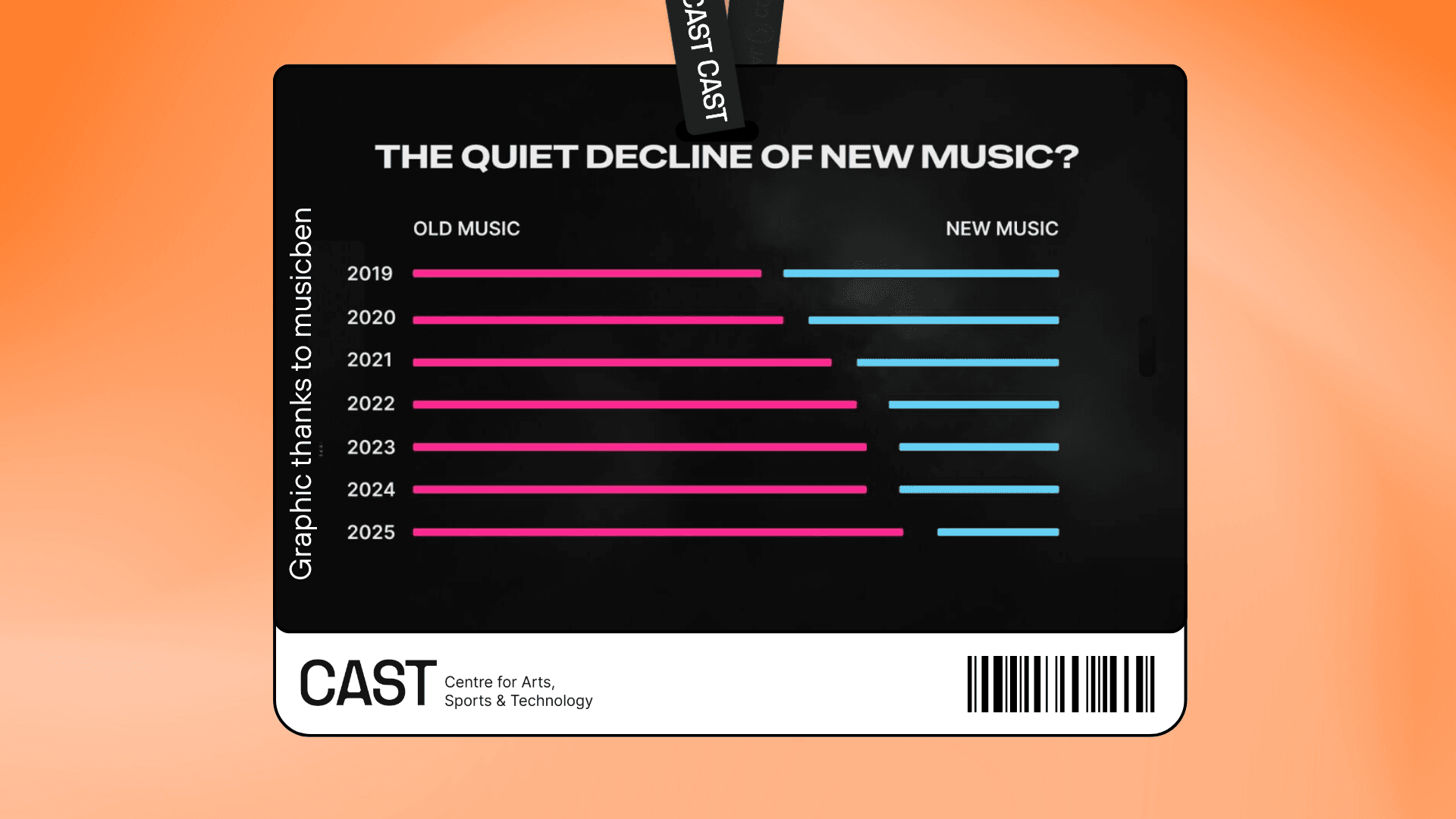
***GRAPHIC THANKS TO MUSICBEN***
_______________________________
What if, on the day Spotify launched in 2008, the industry had implemented a different structure for royalty distribution? What if that structure had better supported emerging artists? What would that have meant for today’s artists?
Let’s go back to 2008. The deals between the majors and Spotify are being negotiated. The infrastructure for how a trillion streams will be paid out over the next two decades is being set. What if that conversation had gone differently?
Here’s a few different ways payouts could have gone. **noting these figures could be adjusted, this is more about the mechanism vs the flat rate pool that the majors negotiated.
_______________________________
Path One: Progressive payouts tied to monthly listeners
The model is straightforward. Up to 250,000 monthly listeners, the rate is unchanged, full payout, as it is today. Above that threshold, a gradually increasing share flows to a pool, rising to 30% at 36 million monthly listeners, the approximate entry point for the global top 100. Everything below the threshold is untouched. Everything above contributes a small, growing percentage to what comes next.
A band with 50,000 monthly listeners releases a song at the start of 2026 that picks up 300,000 streams. At today’s standard rate of $0.0032 per stream, that track has earned roughly $954. Under this mechanism, with a rate closer to $0.0062 per stream, that same track would have earned roughly $1,854. Almost double, on one track.
Across a year, roughly 2.4 million streams at that listener level, today’s rate puts annual royalties around $7,632. Under this model, that becomes closer to $14,832. An extra $7,200 a year.
Applied from day one of streaming, this model would have redirected roughly $16.9 billion over 18 years, about $890 million a year on average, growing to $2 billion annually by 2026. 54.6% of that, roughly $9.2 billion, would have landed in the last five years alone. Over the coming five years, the pool is projected to reach $11.8 billion, an average of $2.4 billion a year.
_______________________________
Path Two: Royalty rates that gradually reflect a song’s age
The model starts at full rate for every track from day one. At year 10, a gradual decline begins. By year 70, roughly where copyright protection winds down anyway, the rate reaches zero. The difference, year by year, flows into a pool that lifts the rate for newer music.
|Catalogue age - Rights holder retains -To new-artist pool - Effective rate
|Year 0 |100% |0% |$0.00318
|Year 10 |100% |0% |$0.00318
|Year 20 |83.3% |16.7% |$0.00265
|Year 30 |66.7% |33.3% |$0.00212
|Year 40 |50.0% |50.0% |$0.00159
|Year 50 |33.3% |66.7% |$0.00106
|Year 60 |16.7% |83.3% |$0.00053
|Year 70 |0% |100% |$0.00000
The same band’s song, 300,000 streams in 2026, earns $954 today. Under this model, the pool generated by ageing catalogue lifts their effective rate to around $0.00449 per stream. That same track earns closer to $1,347. Around 40% more.
Annually, $7,632 today becomes around $10,772. An extra $3,140 a year.
Applied from day one of streaming, this model would have redirected roughly $30.9 billion over 18 years, about $1.6 billion a year on average, growing to $3.7 billion annually by 2026. 54.6% of that gain, roughly $16.9 billion, would have landed in the last five years. Over the coming five years, the projected total reaches $21.7 billion, an average of $4.3 billion a year.
_______________________________
Path Three: Double the rate for the first three years of a song’s life
The model is binary. No sliding scale, no thresholds. A track releases. For three years, it earns double the standard rate. After year three, it earns a reduced standard rate. These first three years are the most difficult for artist, it’s when they are playing shows for no money, investing their own money in recording and earning little to no money for streaming, syncs and radio plays.
First 3 years - $0.00636 (2x current rate)
After 3 years- $0.00194 (61% of current rate)
The same band’s song earns $1,908 instead of $954. Exactly double. Annually, $7,632 becomes $15,264. An extra $7,632 a year, the largest uplift of any of the three paths.
A song that has already had its moment earns roughly 39% less per stream after year three.
Applied from day one, this model would have redirected roughly $52.6 billion over 18 years — the largest shift of any path in this series. 54.6% of that gain, roughly $28.7 billion, would have landed in the last five years alone. Over the coming five years, the projected total reaches $36.9 billion, an average of $7.4 billion a year.
_______________________________
What each of these paths share
Each model starts from the same place: $187.7 billion in total streaming revenue generated between 2008 and 2026. The platform pays the same amount. The total pool doesn’t change. What changes is where that money arrives.
Worth noting where the example band actually sits: 50,000 monthly listeners already places them in roughly the top 0.5% of all artists on Spotify. Of the platform’s 11 million artists, 86% never reach 1,000 monthly listeners. This band has real momentum. The current system just doesn’t reflect it in their payout.
_______________________________
The bigger picture
Since 2019, more than $20 billion has flowed into music catalogue acquisitions, investment firms buying up the rights to decades-old music. Springsteen’s catalogue sold for around $550 million. Dylan’s for $300 million. Sting, Bieber, Bowie, Pink Floyd, all multi-hundred-million-dollar deals. These are smart investments precisely because older catalogue earns steadily and predictably for decades under the current model.
Now imagine that same capital looking at a different opportunity under any of these paths. Not “buy the rights to music that already exists.” Instead, “invest in the artists generating tomorrow’s catalogue.” If new music paid out at meaningfully higher rates, investing in emerging artists becomes its own asset class. *** noting some of these models do this better than others***. The same capital currently flowing toward legacy catalogue could flow toward what’s being made right now.
For the music industry to take a shape that is sustainable, it needs structures that encourage the behaviours it wants to see. Is it:
A) Investment in emerging artists, better support for the early years?
B) a continuation of the current status quo?
It’s an important moment right now as the conversation on AI continues for us to hear the future that the Industry wants and to say it out aloud.